
Teacher Stress Management Tips to Prevent Burnout
Learn effective teacher stress management techniques like mindfulness and time management to reduce burnout and improve well-being.
Oct 11, 2025
Status

Teaching is one of the most rewarding professions, yet it consistently ranks among the most stressful. The constant demands of lesson planning, grading, classroom management, and parent communication create a high-pressure environment that can quickly lead to burnout. This cycle impacts not only your personal well-being but also your effectiveness and passion for education. Effective teacher stress management is not a luxury; it's a fundamental component of a sustainable and fulfilling career.
This guide moves beyond generic advice like "take a deep breath" and offers a comprehensive roundup of evidence-based strategies tailored specifically for educators. We will explore a diverse set of actionable techniques designed to provide both immediate relief and long-term resilience. You will learn how to implement practical methods for a variety of challenges, including:
Mindfulness and cognitive reframing to shift your perspective.
Time-blocking and boundary-setting to protect your personal time.
Simplified grading workflows that reduce your administrative load.
Quick relaxation exercises you can use between classes.
Each strategy is presented with clear, step-by-step instructions to help you navigate the daily pressures of the classroom with renewed energy and focus. Consider this your toolkit for reclaiming your peace in a demanding profession.
1. Mindfulness Meditation
Mindfulness meditation is the practice of focusing your awareness on the present moment. It involves observing your thoughts, feelings, and bodily sensations without judgment. For educators, this is a powerful tool for effective teacher stress management, providing a way to detach from the chaos of the school day and cultivate a sense of inner calm. The goal isn't to stop thinking but to change your relationship with your thoughts, preventing them from overwhelming you.
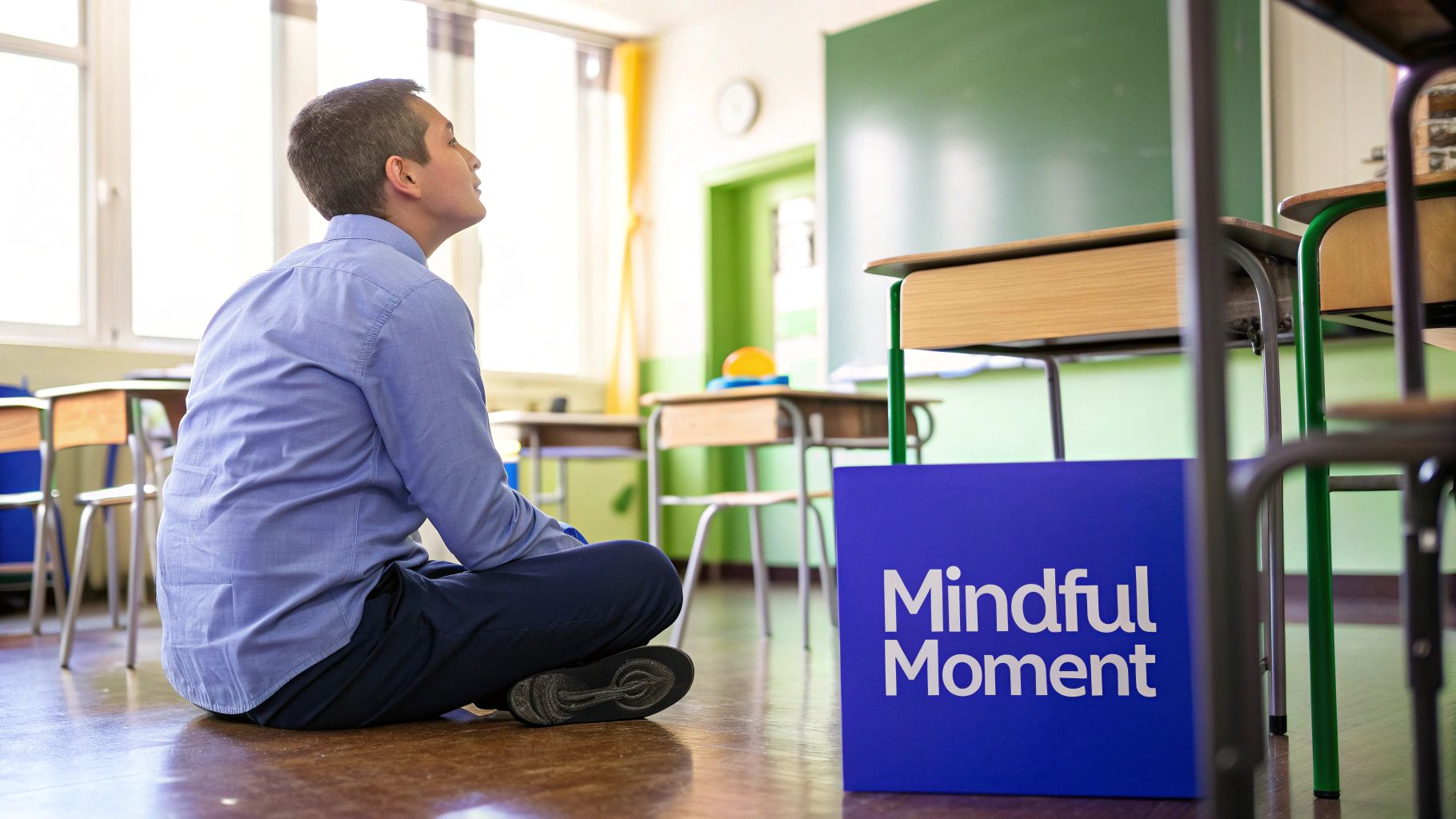
This practice grounds you in the present, which helps reduce the anxiety tied to future lesson plans or past classroom challenges. Pioneered in Western contexts by Jon Kabat-Zinn, and adapted for educators by experts like Patricia Jennings, mindfulness is proven to enhance emotional regulation and reduce burnout. For instance, the UK's Mindfulness in Schools Project was shown to reduce teacher burnout rates by an incredible 35%.
When and Why to Use This Approach
Use mindfulness meditation when you feel your emotional responses becoming disproportionate to the situation, such as feeling intense frustration over a minor student disruption. It is especially effective during high-stress periods like parent-teacher conferences, exam weeks, or before a difficult classroom observation. It creates mental space, allowing you to respond thoughtfully rather than react impulsively.
Actionable Tips for Implementation
Start Small: Begin with just three to five minutes before school. Sit in your car or at your desk and focus on your breath to set a calm intention for the day.
Use Mindful Transitions: As students move between activities or classes, take 30 seconds to close your eyes, take one deep breath, and reset your focus.
Leverage Technology: Use guided meditation apps like Calm or Headspace during your lunch break. Headspace for Educators even offers a free program specifically for K-12 teachers.
Try a Body Scan: After a long day on your feet, lie down at home and mentally scan your body from toes to head, noticing and releasing tension in each area. This helps disconnect from physical stress.
Create a Reset Corner: Designate a small, quiet corner in your classroom. When you feel overwhelmed, take a one-minute break there to breathe and recenter yourself.
2. Time-Blocking and Boundary Setting
Time-blocking is a strategic time management method where you schedule specific blocks of time for particular tasks. When combined with setting firm boundaries, it becomes a powerful technique for teacher stress management, directly addressing the pervasive issue of work seeping into evenings and weekends. This approach helps educators reclaim their personal time by creating a clear, sustainable structure that prevents burnout and mental exhaustion.

By assigning every minute of your workday a job, you minimize decision fatigue and create focus. This concept has been championed by experts like Cal Newport and adapted for education by figures such as Angela Watson, whose '40 Hour Teacher Workweek' program has helped countless teachers reclaim 10-15 hours per week. Schools that support these boundaries, such as implementing 'no email after 6 pm' policies, have seen teacher stress reports drop by as much as 40%. For more insights, explore these teacher time management strategies.
When and Why to Use This Approach
Use this approach when you feel like you are "always on," constantly checking emails, or spending your entire Sunday dreading the week ahead. It is particularly crucial if your to-do list feels endless and unstructured, leading to long hours with little to show for it. Time-blocking creates a proactive rather than reactive workflow, ensuring that high-priority tasks like lesson planning and grading get the dedicated attention they need without sacrificing your personal life.
Actionable Tips for Implementation
Plan Your Blocks Weekly: Use Sunday evening to map out your major work blocks for the week ahead, including planning periods, grading sessions, and parent communication times.
Batch Similar Tasks: Dedicate a specific 90-minute block to grade all quizzes from one class. This "batching" improves efficiency and reduces the emotional drain of task-switching.
Set Communication Boundaries: Establish and communicate "office hours" for responding to parent and student emails. Use an auto-responder outside of these hours to manage expectations.
Schedule Your Departure: Commit to leaving the school building at a set time each day. This creates a hard stop that forces you to prioritize your most important tasks during contract hours.
Protect Your Personal Time: Block out non-negotiable personal activities first, like gym sessions or family dinners. Designate at least one full weekend day as a completely work-free zone.
3. Physical Exercise and Movement
Regular physical activity is one of the most effective techniques for teacher stress management, providing a crucial outlet for the mental and physical demands of the profession. It works by reducing stress hormones like cortisol and releasing endorphins, the body's natural mood elevators. This practice directly counteracts the physical toll of long hours spent standing, sitting in meetings, and carrying accumulated tension.
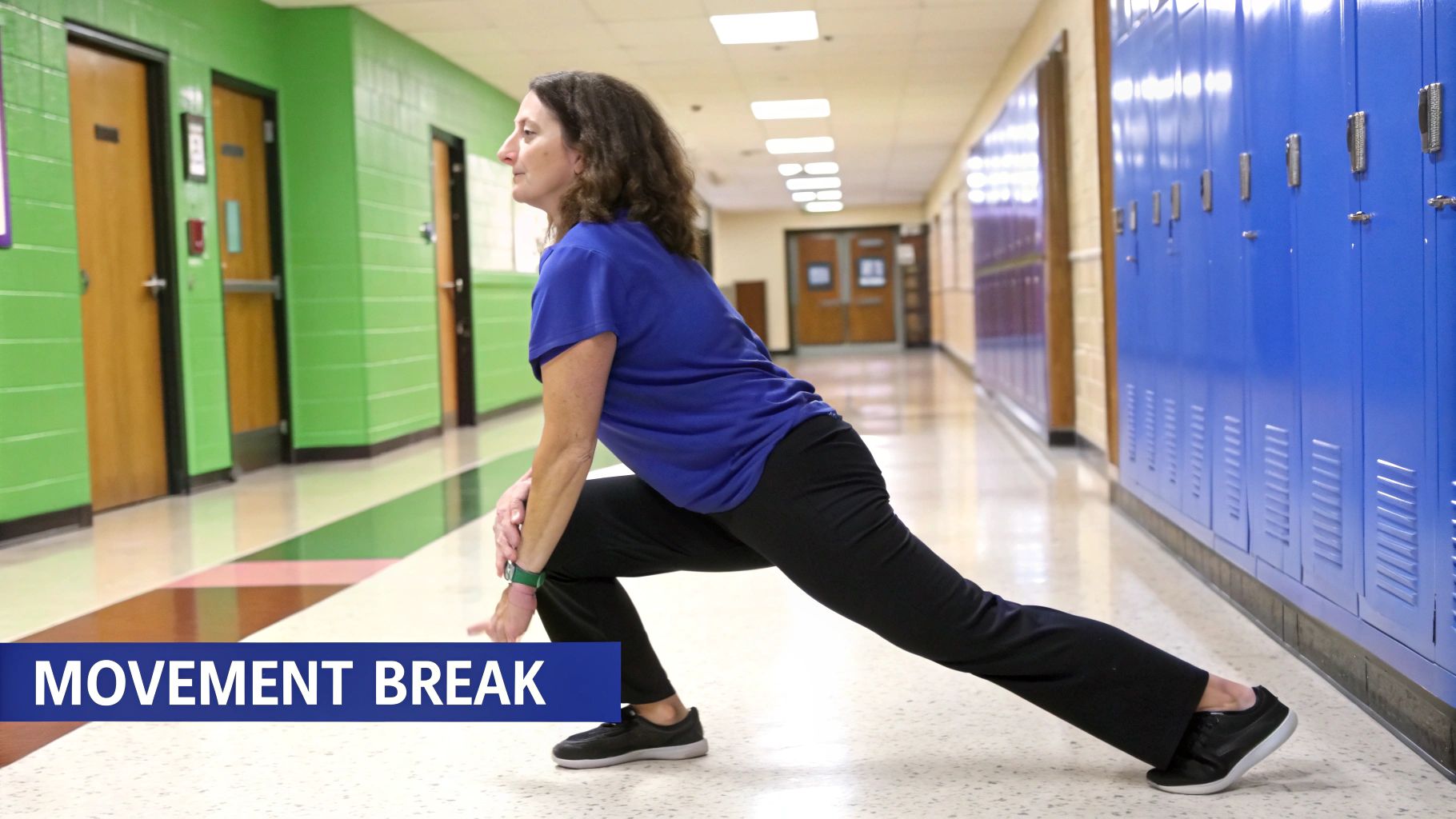
This approach addresses both the sedentary and high-stress aspects of teaching, boosting energy and cognitive function. Popularized by experts like Dr. John Ratey in his book Spark, and championed through movements like Yoga for Teachers, the link between exercise and mental well-being is well-documented. For example, a Chicago Public Schools program that offered free yoga classes saw a 22% reduction in teacher sick days, showcasing the direct benefits on school-wide wellness.
When and Why to Use This Approach
Use physical exercise when you feel mentally drained, physically stiff, or emotionally irritable after a long school day. It is especially beneficial for releasing pent-up energy and frustration that can accumulate in a high-stakes classroom environment. Integrating movement before school can set a positive tone for the day, while an after-school session can create a clear boundary between work and personal life, helping you decompress and reset.
Actionable Tips for Implementation
Start with Micro-Movements: Begin with 10-minute walks during your prep period or lunch break. Keep a pair of sneakers at school to make impromptu walks easy.
Find a Colleague Accountability Partner: Commit to a walking group or after-school gym session with a fellow teacher. Shared goals significantly increase consistency.
Try Desk Stretches: Between classes or while students are working independently, perform simple neck, shoulder, and back stretches to release tension.
Leverage HIIT Workouts: Use a 7-minute HIIT (High-Intensity Interval Training) app at home. These short, effective workouts can easily fit into a packed schedule.
Walk During Parent Calls: If a phone call doesn't require you to be at your computer, take the call while walking around the school grounds to incorporate movement.
4. Cognitive Reframing and Perspective Shifting
Cognitive reframing is a psychological technique for identifying and challenging negative or unhelpful thought patterns. Instead of letting automatic negative thoughts dictate your emotional state, you consciously replace them with more balanced and realistic perspectives. This approach is a cornerstone of effective teacher stress management because it directly targets common cognitive distortions like catastrophizing ("This entire school year is ruined!") or personalization ("That student's bad behavior is my fault.").
This method, rooted in the work of cognitive therapy pioneers like Aaron Beck and Albert Ellis, empowers educators to regain control over their internal narrative. For example, research into programs like CARE for Teachers, which incorporates cognitive reframing, has demonstrated significant reductions in psychological distress. Similarly, studies have shown that teachers trained in cognitive-behavioral techniques report up to a 45% reduction in perceived stress, proving its efficacy in real-world school settings.
When and Why to Use This Approach
Use cognitive reframing when you find yourself caught in a loop of negative self-talk, especially after a challenging lesson, a difficult parent interaction, or receiving critical feedback. It is most powerful when you feel overwhelmed by a situation and your thoughts are making it worse. This technique helps you separate the objective facts of an event from your subjective, and often harsh, interpretation of it, allowing you to find a more constructive path forward.
Actionable Tips for Implementation
Keep a Thought Log: For one week, jot down stressful situations and the automatic thoughts that follow. This helps you identify recurring negative patterns you can work on.
Challenge Your Beliefs: When a negative thought arises, ask yourself, "What is the evidence that contradicts this thought?" and "What is a more helpful way to see this?"
Reframe Specific Scenarios: Instead of thinking, "That parent is attacking me," try reframing it as, "That parent is advocating for their child out of concern."
Use the "ABCs": Identify the Activating event (e.g., a lesson bombs), your Belief about it ("I'm a terrible teacher"), and the Consequence (feeling defeated). Actively challenge the belief to change the consequence.
Write It Down: Physically writing down your reframed thought (e.g., "This lesson didn't work today; I'll adjust it for tomorrow") helps solidify the new, more positive neural pathway.
5. Peer Support and Teacher Communities
Peer support and teacher communities involve creating or joining networks of educators who provide emotional validation, practical advice, and a sense of belonging. This approach directly combats the professional isolation many teachers feel, creating a crucial buffer against burnout. It operates on the principle of shared experience, where collective problem-solving and normalized struggles build resilience.
This method provides an invaluable layer of teacher stress management by reminding you that you are not alone in your challenges. Authors like Elena Aguilar, in her book Onward: Cultivating Emotional Resilience in Educators, champion the power of community to sustain teachers. Evidence supports this: schools with structured mentoring programs see up to 30% higher new teacher retention rates, demonstrating the profound impact of connection. Similarly, massive online groups like the Teacher Support Teacher Facebook community show that peer advice can be a daily lifeline.
When and Why to Use This Approach
Engage with peer communities when you feel isolated in your struggles or are facing a challenge you believe is unique to you. It's especially powerful after a difficult classroom day, a negative parent interaction, or when you are implementing a new curriculum and need practical advice. The community provides perspective, reminding you that your feelings are valid and your problems are often shared, which reduces feelings of failure and frustration.
Actionable Tips for Implementation
Initiate a Check-In: Start a weekly 15-minute check-in with a trusted teacher friend. Use this time to share one win and one challenge from your week.
Join an Online Community: Participate in forums or social media groups like the #teachertwitter hashtag on X (formerly Twitter). These provide 24/7 access to a global network of educators.
Establish a Problem-Solving Pact: Create a rule with your colleagues: no complaining without also brainstorming a potential solution. This shifts the group dynamic from venting to empowerment.
Find or Become a Mentor: Seek out a formal or informal mentorship. The reciprocal nature of this relationship offers support and professional growth for both parties.
Organize Social Events: Plan a monthly teacher social gathering completely unrelated to schoolwork, such as a book club, walking group, or potluck, to build personal connections.
6. Breathing Techniques and Quick Relaxation Exercises
Breathing techniques are physiological interventions involving controlled breathing patterns to activate the parasympathetic nervous system, our body's "rest and digest" response. For educators, these are invaluable for effective teacher stress management because they can be done discreetly and quickly, providing immediate relief without needing special equipment or leaving the classroom. The core principle is that by intentionally slowing and deepening your breath, you can directly influence your heart rate, blood pressure, and overall feeling of calm.
These practices are not new; they have roots in ancient traditions but have been popularized by modern experts like Dr. Andrew Weil (4-7-8 breathing) and even the U.S. Navy SEALs (box breathing) for their proven ability to regulate stress in high-pressure situations. Research from psychiatrists like Dr. Richard Brown confirms that specific breath patterns can powerfully alter mood and reduce anxiety. For instance, teachers using box breathing before a challenging parent conference often report feeling more centered and less reactive.
When and Why to Use This Approach
Use breathing techniques when you need an immediate, in-the-moment reset. They are perfect for those sudden spikes in stress, like when technology fails during a lesson, a classroom conflict erupts, or you receive an unexpected email from an administrator. It is also highly effective as a proactive tool, used before predictable stressors like standardized testing periods or formal evaluations to establish a baseline of calm. The goal is to interrupt the physiological stress cycle before it escalates.
Actionable Tips for Implementation
Practice Box Breathing: Inhale for a count of four, hold your breath for four, exhale for four, and hold again for four. Use this discreetly while students are working independently.
Try 4-7-8 Breathing: Inhale through your nose for four seconds, hold your breath for seven, and exhale audibly through your mouth for eight seconds. This is excellent for decompressing during your lunch break.
Use Breath-Powered Transitions: Take three intentional, deep breaths before you open your classroom door in the morning or as you walk from the staff room to your next class.
Set Digital Reminders: Use your phone or smartwatch to set a recurring reminder during your planning period to simply stop and breathe for 60 seconds.
Teach Your Students: Introduce a simple technique like "balloon breathing" (placing hands on the belly to feel it expand) as a whole-class reset tool, benefiting everyone’s emotional regulation.
7. Simplified Grading and Assessment Strategies
Simplified grading and assessment strategies involve restructuring evaluation practices to reduce the overwhelming workload that is a primary source of teacher stress. This approach focuses on providing meaningful, timely feedback without spending countless hours on traditional, time-intensive marking. By implementing efficient, educationally sound alternatives, you can reclaim your evenings and weekends while maintaining high academic standards.
This focus on efficiency is a cornerstone of modern teacher stress management, championed by educators like Jennifer Gonzalez and Rick Wormeli. It shifts the goal from marking every single detail to providing targeted feedback that genuinely promotes student growth. Research shows that using single-point rubrics can reduce grading time by up to 60%, and implementing peer or self-assessment strategies can cut a teacher's direct grading load by 40%, all while maintaining student achievement levels.
The infographic below highlights the significant impact that streamlined grading can have on a teacher's workload.
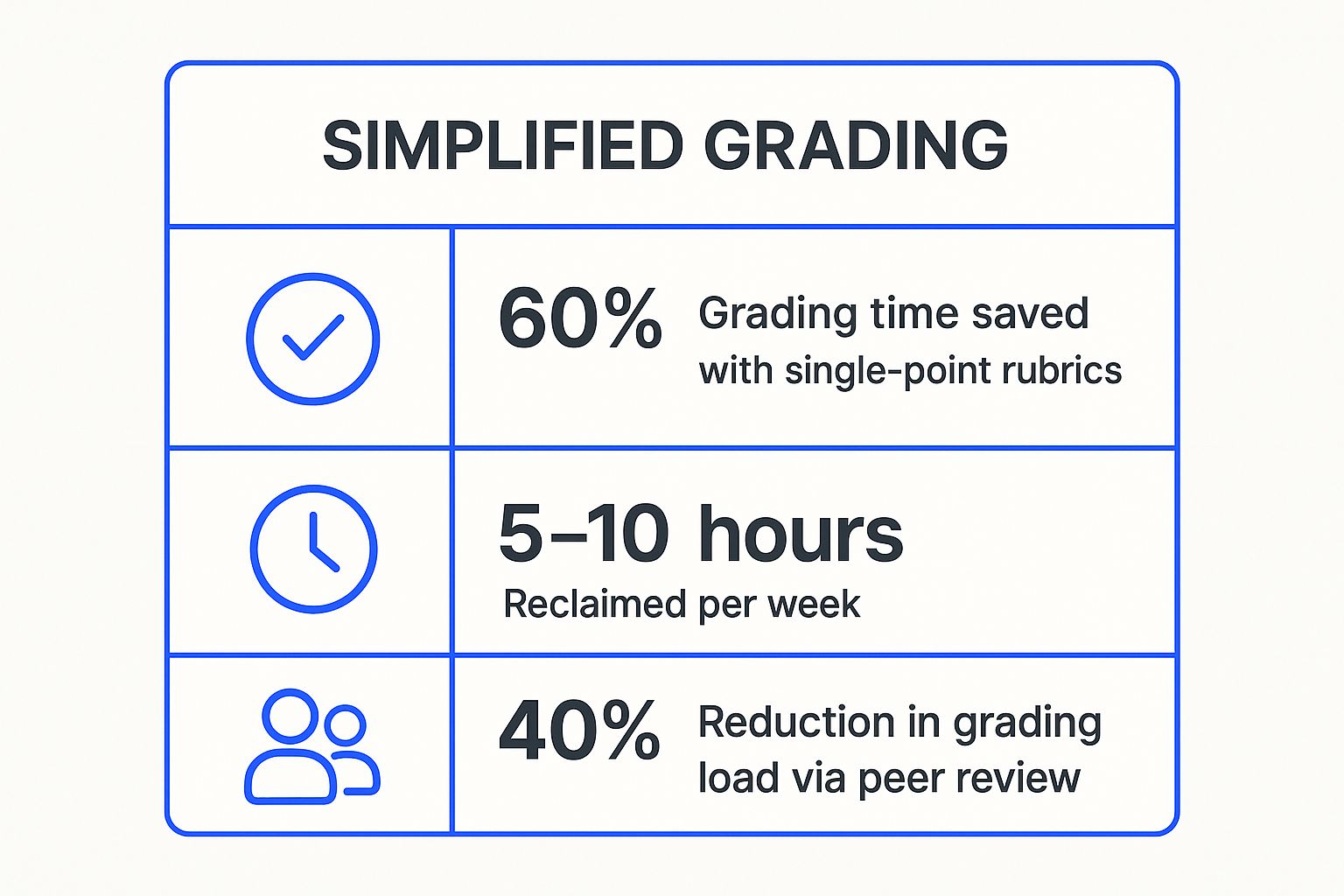
These metrics clearly show that small changes in assessment strategy can lead to a massive reduction in time spent grading, directly combating burnout. For a deeper dive into modern techniques, you can learn more about how to grade smarter, not harder.
When and Why to Use This Approach
Use simplified grading strategies when you find yourself drowning in a mountain of papers, especially during midterms, finals, or after assigning a major project. This approach is ideal when you need to assess for understanding and completion rather than scrutinizing every minor error. It prioritizes your time and energy on high-impact feedback, preventing the burnout that comes from the sheer volume of traditional grading.
Actionable Tips for Implementation
Grade Selectively: Not every problem on an assignment needs a grade. Choose a few key questions that best represent the learning objective and grade only those for accuracy.
Use Whole-Class Feedback: Identify common mistakes across the class and address them in a single mini-lesson instead of writing the same comment on 30 different papers.
Implement Single-Point Rubrics: Instead of a complex, multi-level rubric, use a single-point rubric that only describes the criteria for proficiency. This makes marking faster and feedback more focused.
Leverage Peer and Self-Assessment: Teach students how to use a checklist or rubric to assess their own work or a peer's work before submitting it. You then perform a final, quick spot-check.
Create Comment Banks: Develop a bank of pre-written comments for common feedback points. Digital tools like Google Classroom's comment bank feature can make this incredibly efficient.
8. Professional Boundary and Self-Advocacy Skills
Setting professional boundaries and practicing self-advocacy are crucial skills for long-term teacher stress management. This involves learning to protect your personal time, energy, and resources by communicating your needs clearly and saying 'no' to non-essential demands. For educators, this directly counters the pressure to be endlessly available, preventing the burnout that arises from taking on an unsustainable workload. It’s about shifting from a "do-it-all" mindset to a sustainable professional practice.
This approach, championed by experts like Dr. Brené Brown and teacher advocate Angela Watson, empowers you to define where your professional responsibilities end and your personal life begins. Studies show that teachers who set clear work-life boundaries, such as not answering emails after hours, report significantly lower stress levels and higher job satisfaction. By advocating for your needs, you model healthy behavior for students and maintain the energy required for effective teaching.
When and Why to Use This Approach
Use this approach when you feel overwhelmed by requests for your time, such as being asked to lead another committee, chaperone an extra event, or take on new, unpaid responsibilities. It is essential when you notice your work life consistently infringing on your personal time, leading to exhaustion and resentment. Setting boundaries isn't about doing less; it's about preserving your capacity to do your primary job well, which is a key component of effective classroom management for teachers.
Actionable Tips for Implementation
Practice the Pause: Instead of an immediate "yes," respond with, "Let me check my commitments and I will get back to you." This gives you time to make a thoughtful decision.
Limit Your "Yes": Commit to only one major extracurricular activity or school committee per year. This allows you to contribute meaningfully without overextending yourself.
Establish Communication Boundaries: Set a specific time when you will stop checking or responding to work emails, such as 6:00 PM, and communicate this in your email signature.
Use Clear Language: When declining a request, be polite but firm. A simple, "Thank you for the offer, but I'm at capacity right now," is a complete and professional response.
Identify Your Non-Negotiables: Determine what personal time or activities are sacred to you (e.g., family dinner, daily exercise) and fiercely protect them from work intrusions.
Teacher Stress Management Strategies Comparison
Technique | Implementation Complexity 🔄 | Resource Requirements ⚡ | Expected Outcomes 📊 | Ideal Use Cases 💡 | Key Advantages ⭐ |
|---|---|---|---|---|---|
Mindfulness Meditation | Low to moderate; requires consistent practice | Minimal; no special equipment needed | Reduces teacher stress 20-30%, improves emotional regulation | Stress management, emotional burnout prevention | Builds emotional resilience; flexible timing |
Time-Blocking and Boundary Setting | Moderate; requires discipline and habit formation | Digital tools recommended (calendar apps) | Reduces overtime 10-15 hours, lowers anxiety and burnout | Work-life balance, time management, task batching | Prevents "always on" mentality; improves efficiency |
Physical Exercise and Movement | Moderate; requires regular time commitment | Equipment optional; many free options | Lowers stress hormones by up to 40%, improves sleep and energy | Stress relief, physical health, combating sedentary lifestyle | Immediate and cumulative stress relief; boosts mood |
Cognitive Reframing and Perspective Shifting | Moderate to high; requires cognitive skill development | None required | 45% reduction in perceived stress; improves optimism | Managing negative thoughts, interpersonal conflicts | Provides immediate emotional tools; builds resilience |
Peer Support and Teacher Communities | Low to moderate; depends on group dynamics | Time commitment for meetings or virtual access | Reduces isolation, improves morale and retention | Emotional support, sharing strategies, combating burnout | Emotional validation; practical advice sharing |
Breathing Techniques and Quick Relaxation Exercises | Very low; instantly deployable | None required | Immediate stress relief within 1-2 minutes | Acute stress moments, classroom quick resets | Instant calming effect; discreet and accessible |
Simplified Grading and Assessment Strategies | Moderate to high; requires restructuring systems | Possible tech tools for grading automation | Saves 5-10 hours weekly, reduces grading-related anxiety | Workload reduction, improving feedback quality | Reclaims time; improves feedback; reduces guilt |
Professional Boundary and Self-Advocacy Skills | Moderate; involves communication and negotiation | None needed | Reduces overcommitment stress; improves work sustainability | Preventing burnout, managing expectations | Builds self-respect; models healthy boundaries |
Creating a Sustainable Teaching Practice, One Strategy at a Time
Navigating the demanding landscape of education requires more than just passion and pedagogical skill; it demands a resilient and well-managed inner world. This comprehensive exploration of teacher stress management strategies is designed not as a prescriptive checklist, but as a flexible menu of options. From the anchoring calm of mindfulness meditation and the structural power of time-blocking, to the cognitive agility of reframing and the communal strength of peer support, each technique offers a unique pathway to reclaiming balance and joy in your profession.
The journey to effective stress management is rarely a linear one. It’s an iterative process of experimentation and adaptation. The key is to avoid the pressure of implementing everything at once. Instead, view these strategies as building blocks for a more sustainable career. The goal is not to eliminate stress entirely-an impossible feat in a dynamic field like education-but to build the capacity and skills to navigate it effectively, transforming it from a debilitating force into a manageable part of your professional life.
Your Personal Action Plan for Lasting Well-Being
The most powerful takeaway is that you are in control of this process. True, systemic issues contribute to teacher burnout, but cultivating personal stress management skills provides an immediate and impactful buffer. It empowers you to protect your energy, set healthy boundaries, and model resilience for your students.
To begin, consider these actionable next steps:
Identify Your Biggest Stressor: Which of the eight strategies directly addresses your most significant pain point right now? If grading consumes your nights, start with Simplified Grading and Assessment Strategies. If classroom chaos feels overwhelming, begin with Breathing Techniques and Quick Relaxation Exercises.
Start Small and Build Momentum: Choose just one practice to implement this week. Commit to a two-minute breathing exercise before the bell rings or time-block a single 30-minute "no work" window in the evening. Small, consistent wins build the confidence needed for bigger changes.
Find an Accountability Partner: Share your chosen strategy with a trusted colleague from your Peer Support Community. A simple check-in can provide the motivation needed to stay on track, reinforcing the idea that you are not alone in this effort.
Ultimately, mastering teacher stress management is a profound act of self-advocacy and a direct investment in your students' success. A well-regulated, present, and energized teacher creates a classroom environment where learning can flourish. By prioritizing your own well-being, you are not taking away from your students; you are ensuring you can give them your best, day after day, for years to come. This is how you build a long, fulfilling, and impactful career in education-one intentional strategy at a time.
Ready to reclaim countless hours and significantly reduce your grading workload? Discover how GradeWithAI uses ethical AI to provide meaningful, personalized feedback on student work in a fraction of the time, directly addressing one of the biggest sources of teacher stress. Learn more and start your free trial at GradeWithAI.